https://w3id.org/ocqa/adaptive#To represent different states of inspection plans and related information, OCQA-Adaptive uses contextualization. The framework defines contexts to structure inspection-related data and support adaptive planning of quality inspections during construction. Instead of overwriting values, evolving information is represented in contexts so that different states can be tracked, compared, and reused. Context can be represented using qualified properties, objectified properties, or named RDF graphs. While an ontology provides a shared vocabulary, context specifies the conditions under which that vocabulary is applied, allowing conflicting representations to coexist in one knowledge base and enabling systematic comparison and reasoning.
OCQA-Adaptive follows the FAIR principles and is accessible at https://w3id.org/ocqa-adaptive#.
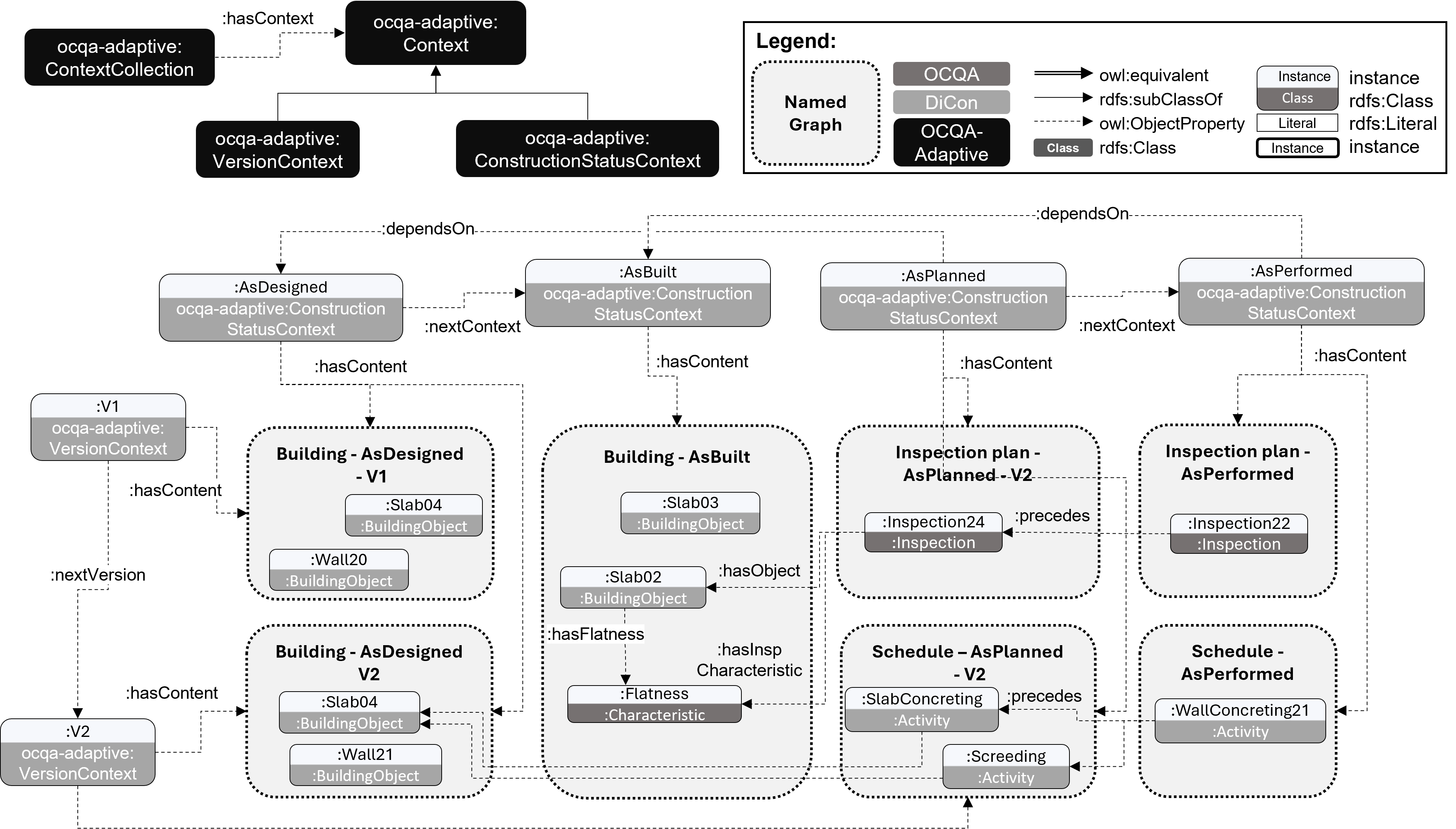
Contextual information is represented using named graphs due to high performance and reduced complexity.
Named graphs support versioning and status tracking of entities such as inspections and building objects.
Each named graph is linked via ocqa-adaptive:hasContent to an instance of
ocqa-adaptive:Context that captures version or status metadata.
Version-related named graphs capture releases and changes to information models; micro changes can be
recorded within the named graph using qualified or objectified properties.
In parallel, OCQA-Adaptive provides an orthogonal layer that represents the current status of project
entities using four contexts:
As-Designed, As-Built, As-Planned, and As-Performed.
By linking contexts with relations such as ocqa-adaptive:dependsOn and
ocqa-adaptive:nextContext, the framework supports adaptive inspection planning across the
construction lifecycle and enables comparisons between planned and performed inspections and between design
and construction states.
Contexts can also be grouped using ocqa-adaptive:ContextCollection, for example by spatial,
temporal, or authorization status, supporting transparent long-term tracking and dynamic adaptation.
| URI | http://www.w3.org/2000/01/rdf-schema#Resource |
|---|---|
| Description |
Generic resource. |
| In domain of |
graph ownerdp graph upload datedp sourcedp |
| In range of |
has contentop |
| URI | https://w3id.org/digitalconstruction/0.5/Contexts#ContextFramework |
|---|---|
| Super-classes |
context collectionc |
| URI | https://w3id.org/digitalconstruction/0.5/Contexts#ContextSet |
|---|---|
| Super-classes |
context collectionc |
| URI | https://w3id.org/ocqa/adaptive#ConstructionStatusContext |
|---|---|
| Description |
Context describing the construction status. |
| Super-classes |
contextc |
| Members |
AsBuilt AsPlanned AsPerformed AsDesigned |
| URI | https://w3id.org/ocqa/adaptive#Context |
|---|---|
| Description |
Context used to characterize information by using named graphs. |
| Sub-classes |
construction status contextc version contextc |
| In domain of |
depends onop has contentop next contextop |
| In range of |
depends onop has contextop next contextop |
| URI | https://w3id.org/ocqa/adaptive#ContextCollection |
|---|---|
| Description |
Combines dicc:ContextSet and dicc:ContextFramework into a single class. This enables an easier and faster definition of different framework collections according to themes such as temporal aspects (status and versioning), level of development, context ownership, approval and authorization status by e.g. owner or authority and spatial grouping But we recommend to use differnt subclasses for context to keep track of about the meaning of the context. Like using the statusContext subclass instead of using a ContextCollection. This reduces the complexity far more. |
| Sub-classes |
dicc:ContextSetc dicc:ContextFrameworkc |
| In domain of |
has contextop |
| URI | https://w3id.org/ocqa/adaptive#dependsOn |
|---|---|
| Description |
Relates a context to another context it depends on. |
| Equivalent properties | dicc:dependsOn |
| Domain(s) | contextc |
| Range(s) | Contextc |
| URI | https://w3id.org/ocqa/adaptive#hasContent |
|---|---|
| Description |
Links a context to the resource that represents its content. |
| Super-properties | owl:topObjectProperty |
| Equivalent properties | dicc:hasContent |
| Domain(s) | contextc |
| Range(s) | rdfs:Resourcec |
| URI | https://w3id.org/ocqa/adaptive#hasContext |
|---|---|
| Description |
Links a context collection to a contained context. |
| Super-properties | owl:topObjectProperty |
| Equivalent properties | dicc:hasContext |
| Domain(s) | context collectionc |
| Range(s) | Contextc |
| URI | https://w3id.org/ocqa/adaptive#nextContext |
|---|---|
| Description |
Relates a context to the next context in a sequence. |
| Super-properties | owl:topObjectProperty |
| Equivalent properties | dicc:nextContext |
| Domain(s) | contextc |
| Range(s) | Contextc |
| URI | https://w3id.org/ocqa/adaptive#hasGraphUploadDate |
|---|---|
| Description |
Timestamp when the graph was uploaded. |
| Super-properties | owl:topDataProperty |
| Domain(s) | rdfs:Resourcec |
| Range(s) | xsd:dateTimec |
| URI | https://w3id.org/ocqa/adaptive#hasOwnerOfGraph |
|---|---|
| Description |
Name of the owner of the graph. |
| Super-properties | owl:topDataProperty |
| Domain(s) | rdfs:Resourcec |
| Range(s) | xsd:stringc |
| URI | https://w3id.org/ocqa/adaptive#hasSource |
|---|---|
| Description |
Source identifier or reference for the resource. |
| Super-properties | owl:topDataProperty |
| Domain(s) | rdfs:Resourcec |
| Range(s) | xsd:stringc |
| URI | http://purl.org/dc/terms/creator |
|---|---|
| Description |
Indicates the agent that created the resource. |
| URI | http://purl.org/dc/terms/description |
|---|---|
| Description |
Provides a textual description of the resource. |
| URI | http://purl.org/dc/terms/issued |
|---|---|
| Description |
Date of formal issuance of the resource. |
| URI | http://purl.org/dc/terms/license |
|---|---|
| Description |
Link to the license governing use of the resource. |
| URI | http://purl.org/dc/terms/modified |
|---|---|
| Description |
Date of last modification of the resource. |
| URI |
https://w3id.org/ocqa/adaptive#AsBuilt
|
|---|
| URI |
https://w3id.org/ocqa/adaptive#AsDesigned
|
|---|
| URI |
https://w3id.org/ocqa/adaptive#AsPerformed
|
|---|
| URI |
https://w3id.org/ocqa/adaptive#AsPlanned
|
|---|
| URI |
https://w3id.org/ocqa/adaptive#Version01
|
|---|
| URI |
https://w3id.org/ocqa/adaptive#Version02
|
|---|
https://w3id.org/ocqa/adaptive#https://brickschema.org/schema/Brick#http://www.w3.org/ns/csvw#http://purl.org/dc/elements/1.1/http://purl.org/dc/dcam/http://www.w3.org/ns/dcat#http://purl.org/dc/dcmitype/http://purl.org/dc/terms/https://w3id.org/digitalconstruction/0.5/Agents#https://w3id.org/digitalconstruction/0.5/Contexts#https://w3id.org/digitalconstruction/0.5/Entities#https://w3id.org/digitalconstruction/0.5/Processes#http://usefulinc.com/ns/doap#http://xmlns.com/foaf/0.1/http://www.opengis.net/ont/geosparql#http://www.w3.org/ns/odrl/2/http://www.w3.org/ns/org#http://www.w3.org/2002/07/owl#http://www.w3.org/ns/dx/prof/http://www.w3.org/ns/prov#http://purl.org/linked-data/cube#http://www.w3.org/1999/02/22-rdf-syntax-ns#http://www.w3.org/2000/01/rdf-schema#https://schema.org/http://www.w3.org/ns/shacl#http://www.w3.org/2004/02/skos/core#http://www.w3.org/ns/sosa/http://www.w3.org/ns/ssn/http://www.w3.org/2006/time#http://purl.org/vocab/vann/http://rdfs.org/ns/void#https://www.w3.org/2003/01/geo/wgs84_pos#http://www.w3.org/2001/XMLSchema#| c | Classes |
| op | Object Properties |
| fp | Functional Properties |
| dp | Data Properties |
| ap | Annotation Properties |
| p | Properties |
| ni | Named Individuals |